

Where is Darlington?
JP Spencer, Director of Devolution Policy, ThinkLabour

Today, ThinkLabour launches its new Substack.
We are moving away from our newsletters for our blog posts and instead we are now using this substack! This will be the new home for our blog posts, offering subscribers insights and analysis from both our staff team and external contributors. We’ll be covering the key issues shaping the day, while also exploring important topics that often receive less attention elsewhere in the news. Subscribe to stay informed and be part of the conversation.
Our first piece is by our Director of Devolution Policy, JP Spencer. JP is an economist with over a decade of experience working across economic policy and strategy in both the public and private sectors. This includes roles at HM Treasury, HM Revenue & Customs, Greater Manchester Combined Authority and Metro Dynamics. Outside of Think Labour he is also a Policy Fellow at The Productivity Institute and writes on Substack about the North of England at Future North.
The importance of rationalising the geographic boundaries of our public services
Now, I know where Darlington is. I used to work there. But if I asked you ‘where is Darlington?’ in the sense of which local authority, administrative geography or region then you might struggle.
This is because central government has an addiction to creating new overlapping regional and local government boundaries which leave places in the dark about where they actually are and who is responsible for them. This may sound boring but getting this right will improve how our government functions so that it can deliver properly for everywhere and everyone.
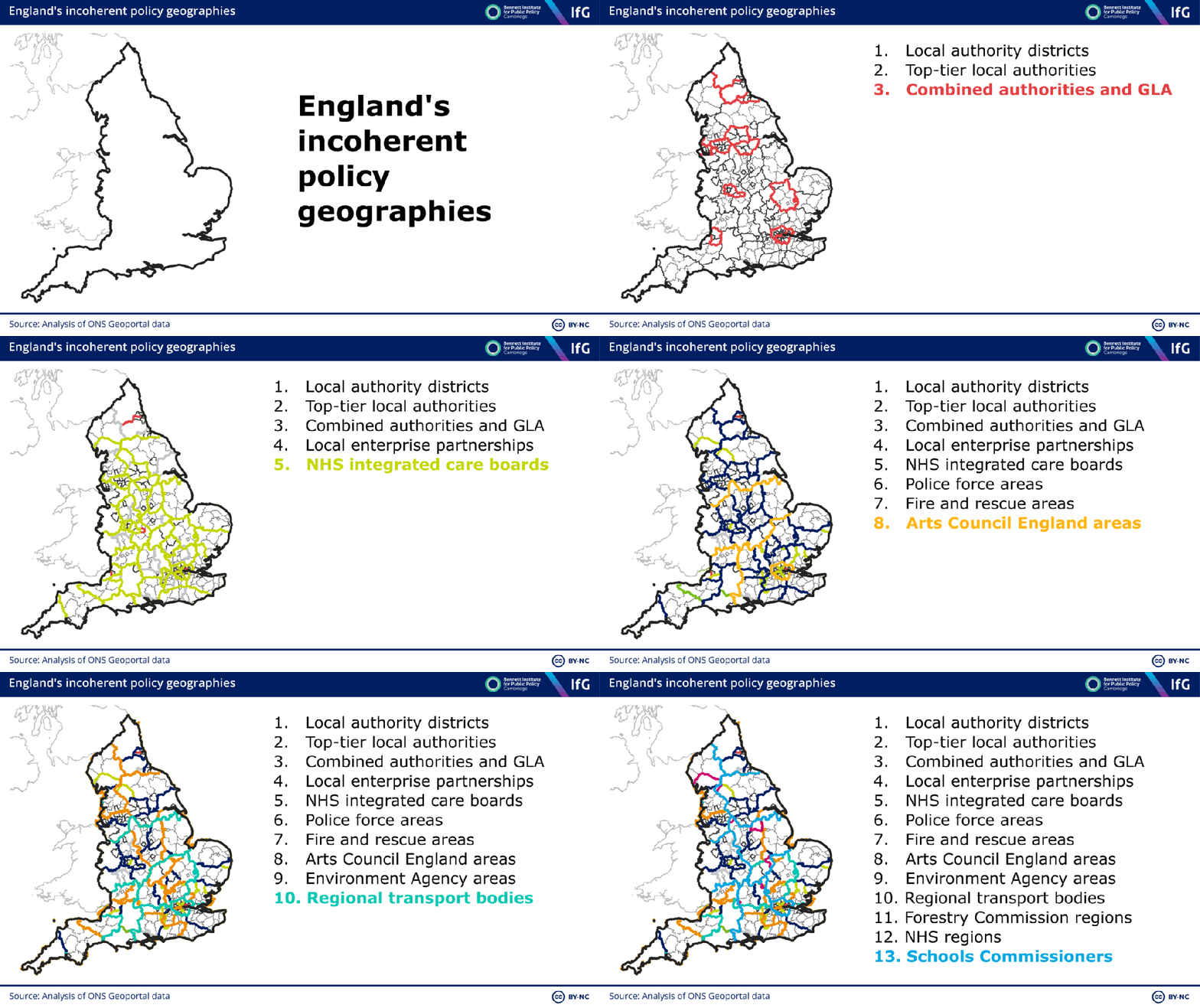
When Jack Newman and Michael Kenny looked at this in 2023 for the Institute for Government and Bennett Institute, they found at least ten different boundaries in use - on top of strategic and local authority boundaries. These range from NHS regions and integrated care boards (ICBs), through police forces and fire and rescue services, to arts council regions and schools commissioner regions. The authors created a gif to show the absurdity of the situation at the time which is available here.
Every other advanced economy manages its subnational services around local democratic boundaries - ranging from US states, Canadian provinces, German lander, French regions and Japanese prefectures to municipalities and villages across every country.
In this context, the 2024 Devolution White Paper made a bold statement, saying that there would be:
“Action to deliver greater public service boundary alignment in the long term, making more Mayors responsible for fire, police, and engaged in Integrated Care Partnerships, and supporting the mayoral convening role in public services, so Mayors and Strategic Authorities can support partners in driving public service reform. This includes clearer expectations for Mayors’ roles in local health systems and in improving population health.”
This is a very sensible policy. Boundary misalignment and consequent complexity is a hidden part of our state failure.
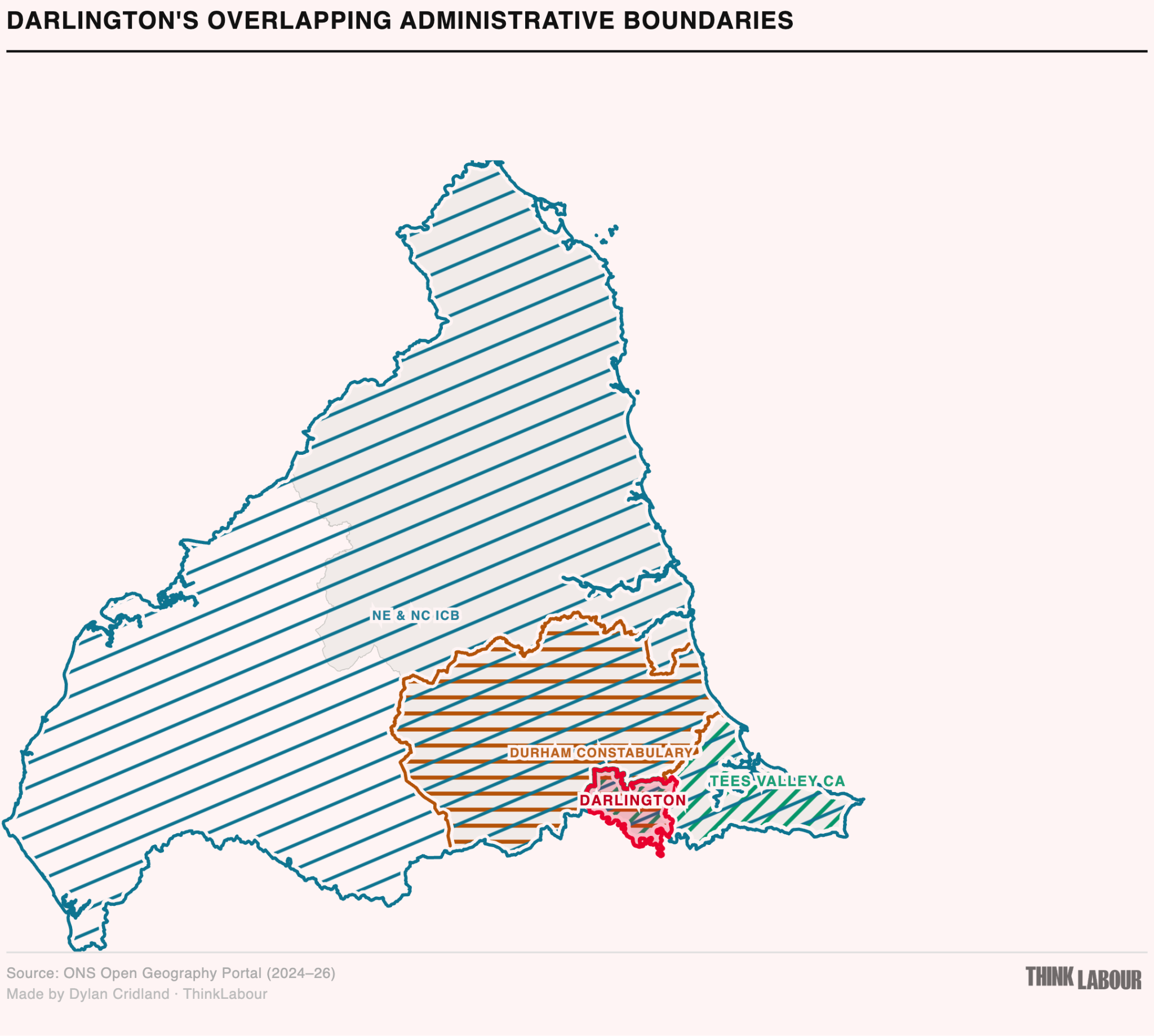
Take our Darlington example. It is a separate unitary authority with historic links to neighbouring County Durham (which is its own separate unitary). The two unitaries are covered by the Durham Constabulary. But Darlington is part of the Tees Valley Strategic Authority, whereas County Durham comes under the purview of the North East Strategic Authority. The health service covers the whole of the North East region (which also includes Tees Valley), but also brings in North Cumbria for health purposes too. The map below shows part of this issue with the differing strategic authority, police and health boundaries of which Darlington is a part. Click here to see more of the boundary complexity in the area.
By creating a complex system that people do not understand, central government undermines accountability and democracy. Sorting it out has two important benefits:
Public Understanding and Accountability - the public are clear on where they live and who is responsible for services. This is difficult when your mayor, police, health and other services all cover different areas. Local accountability for services should be provided by democratic institutions elected by the people in that area. This reinforces the direct link between voting and change which is the essence of democracy - and has broken down given centralisation and outsourcing to unelected agencies. Public and media understanding of how the system works is essential for this to be able to happen. For example, in Darlington, if there is an issue with the police then it might be reasonable to assume that the mayor of the area - Ben Houchen - is responsible like David Skaith, the mayor in neighbouring York and North Yorkshire is. But owing to the boundary differences this actually remains a Durham Police and Crime Commissioner (PCC) issue.
Efficiency - too much emphasis is put on ‘efficiency’ within policy areas without thinking across them. There are three elements of efficiency that can come from simpler boundaries. Firstly, it may allow for a rationalisation of backoffice functions and other shared services. For example, we are seeing this where PCC powers have been given to mayors. Secondly, there are benefits in terms of time - with fewer meetings and stakeholder relationships needed for organisations in different areas. This will help join up services, as we are seeing with increased links between transport and policing in areas where they are aligned, and deal with cross-cutting issues and crises. Thirdly, it will save government time - especially in not needing to spend any more time creating more boundaries.
Despite the clear benefits and commitment from government, we have not seen this policy followed through on by the DHSC with regards to Integrated Care Boards (for example, Cambridgeshire and Peterborough is now part of a larger area). And now the Home Office seems reticent on police forces, with the independent review being clear that other options are on the table. Why is this the case?
It seems that health and police rationalisation are being developed in departmental silos - with teams trying to devise the ‘right’ boundaries for delivery of their service - but without prioritising the impact on other services or on local democracy and understanding.
For example, almost every other G7 or similarly populous developed nation has some form of regional policing based on democratic boundaries, usually with a municipal police below them, supported by specialised national police forces. If the government does not use the police reforms to create such a similar model we will end up moving toward it at some point in the future - at huge extra transitional cost.
So, what does this mean for public services in England?
Public service boundaries should be based on strategic authority areas. The planned creation of strategic authority areas across England in the coming years unlocks the benefits above. This does not mean everything should be devolved. National services will be needed in some areas - like the proposed National Police Service.
And moving to this model will still create some simplification and rationalisation. For example in the police, aligning with likely mayoral strategic authority boundaries would mean a net reduction of about 5 or 6 police forces.
If we do not adopt this model of place-based service boundaries then there will be a constant tendency for the centre to tinker with new boundaries as is the case now. This will leave the issue of policing - and other public service boundaries - unresolved in perpetuity, constantly at the mercy of change. Only having local boundaries that people understand and which align with local democratic institutions will stop this.
The process of getting there will require some work by central government and also by mayors and councils. For some policy areas this might need further legislation, though the English Devolution and Community Empowerment Act enables changes to police boundaries and the recent health boundary changes have not required any primary legislation.
The only long term rational solution is to align public service boundaries with local democratic boundaries - at strategic or local authority level - for the sake of accountability, public understanding and efficiency.
The tendency to lose local knowledge & subject large areas to the needs of the biggest city in the region is often commented on atm. It caused some problems when 999 services became organised regionally. How would you envisage this working at a local level? Would local accountability remain.